
Patricio G. Schlottmann, MD, examines why injection frequency drives treatment failure in wet AMD and the particular challenges facing patients in Latin America.
Patricio G. Schlottmann, MD, examines why injection frequency drives treatment failure in wet AMD and the particular challenges facing patients in Latin America.
Posture, operating room setup, and small workflow adjustments can reduce cumulative neck and back strain over time.
Jay Chhablani, MD, on multimodal imaging, OCT biomarkers, and the importance of early diagnosis as treatment options emerge

In the latest episode of The Retina TL;DR with Dr. Weng, host Christina Y. Weng, MD, MBA, FASRS, talks with Drs. Do, Lad, and Munk about the LIGHTSITE III trial data behind photobiomodulation and what it means for retina practice.
In the latest episode of The Retina TL;DR with Dr. Weng, host Christina Y. Weng, MD, MBA, FASRS, talks with Dr. Dugel about the novel hydrogel-based tyrosine kinase inhibitor platform designed to extend durability and improve long-term outcomes in neovascular AMD.

Leng discusses preliminary results from an ongoing study investigating the interaction between pegcetacoplan and anti-VEGF treatments in patients with GA.
In the latest episode of The Retina TL;DR, host Christina Y. Weng, MD, MBA, FASRS, talks with Dr. Khanani about new retinal gene therapy trials, covering safety, delivery, and ways to reduce treatment burden.
Panelists discuss how emerging therapies—including TKIs, sustained-release implants, and gene therapy—may reduce treatment burden and shift retinal disease management toward longer-acting, maintenance-based approaches.
In the latest episode of The Retina TL;DR with Dr. Weng, host Christina Y. Weng, MD, MBA, FASRS, talks with Dr. Zacks about ONL1204, a first-in-class Fas pathway inhibitor showing promise in neuroprotection for retinal diseases—from retinal detachment to geographic atrophy and glaucoma.
Panelists discuss how aflibercept 8 mg maintains a safety profile similar to 2 mg and how workflow, systemic risk, and patient comfort influence confidence in adopting the higher-dose formulation.
Panelists discuss how clinicians manage suboptimal responders by focusing on stability rather than complete dryness, using multimodal approaches, and avoiding premature treatment switching.
Panelists discuss how trial findings for aflibercept 8 mg and faricimab in RVO demonstrate comparable efficacy and durability, with treatment selection ultimately guided by patient characteristics and future labeling.
Panelists discuss how pivotal RVO trial data for aflibercept 8 mg show strong durability and visual outcomes while raising questions about long-term disease chronicity and vascular remodeling under sustained VEGF suppression.
Panelists discuss how faricimab and aflibercept 8 mg compare in drying and durability and how clinicians manage IOP considerations tied to injection frequency, volume, and syringe variability.
Panelists discuss how real-world adherence to loading doses and thoughtful switching or reloading strategies can optimize durability and outcomes, particularly in undertreated patients.
Panelists discuss how the 8-mg aflibercept formulation improves drying efficacy, extends dosing intervals, and reduces burden while maintaining familiarity for patients across AMD and DME.
Panelists discuss how higher-dose and dual-pathway anti-VEGF agents enable longer intervals, improved fluid control, and more flexible treatment strategies across retinal vascular diseases.
Discover the latest insights on geographic atrophy, its causes, symptoms, and innovative treatment options to manage this eye condition effectively.
Discover the latest insights on geographic atrophy, its causes, symptoms, and innovative treatment options to manage this eye condition effectively.
Explore the complexities of managing geographic atrophy in AMD patients, including treatment decisions and the importance of ongoing monitoring.
Explore the complexities of treating geographic atrophy in elderly patients, focusing on individualized care and decision-making strategies.
Explore the latest advancements in geographic atrophy management, focusing on early detection, imaging tools, and evolving treatment strategies.
Panelists discuss how faricimab’s dual VEGF-A and Ang-2 inhibition may offer vascular stability advantages over single-pathway blockade, despite ongoing questions about Ang-2’s independent therapeutic impact.
Panelists discuss how aflibercept’s structural design and the higher molar dose of its 8-mg formulation enhance VEGF binding, treatment durability, and clinical predictability.
Dr. Sharon Fekrat presented a retrospective analysis assessing how antiplatelet and anticoagulant therapy relates to hemorrhage characteristics and outcomes.
Panelists discuss how key biologic and clinical distinctions—such as ischemia, leakage patterns, and modality-specific insights—guide tailored treatment strategies for BRVO, CRVO, and DME.
Panelists discuss how differing disease mechanisms, inflammatory drivers, and clinical priorities across AMD, DME, and RVO shape individualized therapeutic goals and the use of newer anti-VEGF agents.
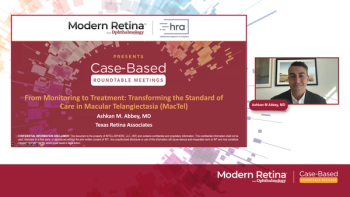
A panelist discusses how careful timing, patient education, and bilateral treatment planning strengthen real-world NT-501 management for MacTel type 2.