



AMD
Latest News


Ocugen doses first patient in Phase 1/2 Clinical Trial evaluating safety, efficacy of OCU410
By David Hutton
Advertisement
Latest Videos
CME Content














Advertisement
More News

The predictive factors were the previous number of anti-vascular endothelial growth factor and the photometry laser flare-cell (LFCP) value.

A retrospective observational study shows BCVA was maintained after 6 months for patients with neovascular AMD.

The company announced key secondary endpoints were achieved with both EYP-1901 doses. These include a more than 80% reduction in treatment burden, with nearly two-thirds of eyes supplement-free up to 6 months.

The investigators wanted to determine if subclinical changes in the blood–aqueous barrier and the retinal physiology developed after anti-VEGF treatments with aflibercept, brolucizumab, and or faricimab .

The ranibizumab biosimilar is a recombinant antigen-binding fragment (Fab).

The company announced a resubmission of the ONS-5010 BLA on track for the end of calendar year 2024, pending final agreement on a clinical trial protocol with the FDA and successful completion of the required additional clinical trial.

By joining the group of physicians, researchers, and industry partners working together to define optimal biomarkers and endpoints in AMD, RetinAI hopes to forge a global retinal imaging initiative targeting research in the disease.

The augmented reality headset compensates for central vision loss to enhance the visual clarity of patients with age-related macular degeneration and other conditions such as Stargardt disease.
Sophie Bakri, MD, spoke with the Ophthalmology Times team about her presentation at this year's American Academy of Ophthalmology meeting titled, "Real world outcomes and treatment patterns with faricimab and AMD FA retina."

Mohammed Genead, MD, CEO of Aviceda spoke with the Ophthalmology Times team about the company's Phase II/III SIGLEC trial part 1 results, which were shared at this year's American Academy of Ophthalmology meeting.

The company also completes enrollment of the multiple ascending dose phase of AMARONE, the first clinical trial of EyeBio’s lead investigational asset Restoret, with favorable initial safety and tolerability at all dose levels.

An anchored matching-adjusted indirect comparison may aid therapeutic decision-making.

The endorsement follows FDA approval in the United States this summer.
These companies will be among those sharing information and data in Boston, Massachusetts November 14-16, 2023.

Researchers found the growth of RPE cells was successfully controlled by the stencil patterns. When RPE cells were not held together correctly, the cells excreted levels of harmful proteins that could contribute to vision loss.
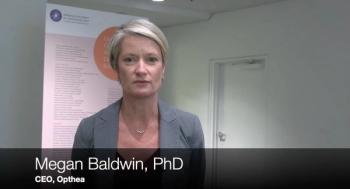
Megan Baldwin, MD, founder of Opthea Limited, spoke with Ophthalmology Times about the company's ShORe and COAST clinical trials at this year's American Academy of Ophthalmology meeting.
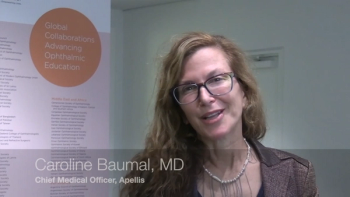
Caroline Baumal, Chief Medical Officer at Apellis, spoke with Modern Retina about the pegcetacoplan GALE extension study for geographic atrophy. She also shared insights regarding her career transition, underscoring the significance of mentorship and a passion for one's work during this year's American Academy of Ophthalmology meeting in San Francisco.
ABP 938 is an investigational biosimilar to EYLEA® (aflibercept).

Patients treated every other month with the drug also showed a similar decrease in the rate of GA progression compared with sham treatment.

According to the study, pegcetacoplan injection reduced nonsubfoveal GA lesion growth by over 40% (monthly) in Year 3 compared to projected sham in the GALE extension study.
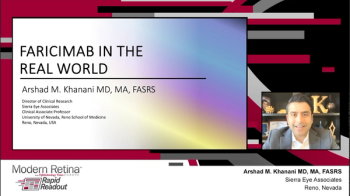
Arshad M. Khanani, MD, MA, FASRS, highlights the fluid resolution with faricimab and the need for loading doses, especially in high-needs switch patients with nAMD or DME.
Arshad M. Khanani, MD, MA, FASRS, discusses rapid improvement with faricimab in several anatomic parameters in treatment-naïve and previously treated patients with nAMD and DME in the TRUCKEE and TAHOE studies.

Launched in 2014, Intelligent Research in Sight is the nation's first and largest comprehensive eye disease registry.

The purpose of this investigation was 2-fold: to estimate the costs of treating GA with pegcetacoplan and to identify possible utility measures to compare treatments for GA.

The clinical trial will evaluate the safety and efficacy of CLS-AX (axitinib injectable suspension), a tyrosine kinase inhibitor. According to the company, topline data is expected during the third quarter of 2024.
Advertisement
Advertisement
Trending on Modern Retina
1
FDA approves ranibizumab-hkdz as first interchangeable biosimilar ranibizumab available in both vials and prefilled syringes
2
Q&A: Peripheral vision IOL's influence on driving performance
3
Phase 3 data support OTX-TKI's durability in wet AMD: 1 injection, 1 year
4
Q&A: Evaluating 24-month outcomes with Abiliti 1-Day in pediatric myopia control
5