














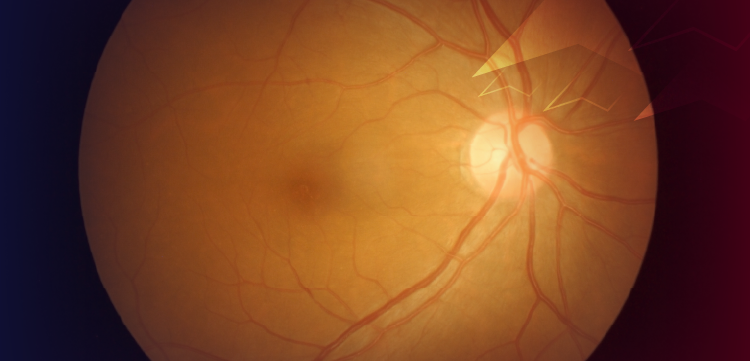






According to Outlook Therapeutics, it is working with the FDA to address the agency’s issues.
According to Outlook Therapeutics, it is working with the FDA to address the agency’s issues.
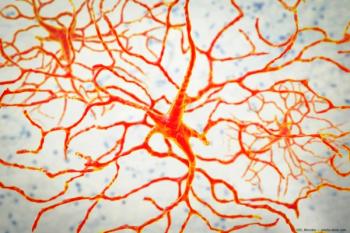
Researchers successfully transplanted human microglia cells into a mouse retina to create a model that could be used to test new treatments for incurable eye diseases.

Adverum Biotechnologies, Inc. provided an update on the company’s ongoing Phase 2 LUNA trial evaluating ixoberogene soroparvovec (Ixo-vec) for the treatment of wet age-related macular degeneration (wet AMD).

The study met its primary efficacy endpoint for the neovascular age-related macular degeneration (nAMD) treatment.

According to Regeneron, visual gains and safety of aflibercept 8 mg remained consistent with the established profile of aflibercept 2 mg injection.
According to the company, the solution slowed the loss of photoreceptors and disease progression as early as six months.
Nancy Lurker, Executive Vice-Chair of the Board of EyePoint Pharmaceuticals, discussed the subgroup analyses of the Phase 1 DAVIO Trial of EYP-1901 with our team at the 2023 ASRS annual meeting.
Megan Baldwin, PhD, CEO and Managing Director of Opthea Limited, spoke with our team about the company's clinical trial drug OPT-302 (sozinibercept) at the 2023 ASRS annual meeting.
At the 2023 ASRS annual meeting, Dante Pieramici, MD, spoke with our team to share information on OPT-302, or sozinibercept, for the treatment of neovascular AMD and other retinal vascular diseases.

In the study, researchers found that nearly one-quarter of anti-VEGF injections were received at least 1 week later than intended.

During presentations at the ASRS 41st Annual Meeting in Seattle, Apellis noted that there was no indication that drug product or manufacturing issues contributed to rare events of retinal vasculitis, and no events were reported in clinical trials.

RGX-314, an investigational formulation being developed in collaboration with AbbVie, may be a potential one-time treatment for nAMD, diabetic retinopathy, and other chronic retinal conditions.
The American Society of Retina Specialists is hosting its annual meeting this year in Seattle, Washington. Our team caught up with Baruch Kupperman, MD, PHD who is presenting, "Improving vision and dry AMD matching mechanism with the right patient population and stage of disease" to learn more about this topic.

With this funding, the DISCOVER study will evaluate the safety and tolerability of three doses of AXT107 in patients with wet AMD.

The results of this study demonstrated the good safety and tolerability of HLX04-O.
Going forward, sozinibercept will be the official moniker of OPT-302, which holds fast track designation from the US Food and Drug Administration (FDA).

Clearside Biomedical developing a long-acting therapy for the treatment of retinal diseases, including wet AMD.

DAYLIGHT is the first of the company's 3 studies and was a randomized, double-masked, active comparator-controlled study evaluating the efficacy and safety of a high-intensity dosing regimen of tarcocimab tedromer.
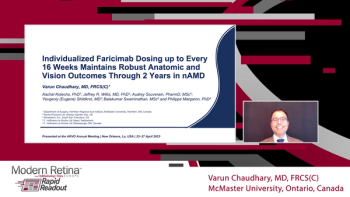
Dr Varun Chaudhary presents the retreatment decisions during the treat-and-extend phase of the TENAYA and LUCERNE clinical trials in neovascular AMD, focusing on the percentage of patients who maintained, extended, or reduced their treatment interval based on visual and anatomic criteria.
Dr Varun Chaudhary discusses the impact of personalized treat-and-extend-based dosing on visual and anatomic outcomes of faricimab in the TENAYA and LUCERNE clinical trials in neovascular AMD.

According to 4DMT, the Dose Expansion stage of the PRISM trial is a multicenter, randomized study designed to evaluate the safety and efficacy of 4D-150 at two different dose levels.

R100 is an adeno-associated virus (AAV) vector invented by 4DMT for intravitreal delivery.

Researchers found that better general health and ability to drive were each separately associated with significantly lower risk of death among individuals with AMD.

While these injections are the standard treatment for this patient population, the investigators found a subgroup of patients who had severe visual loss between 2 consecutive intravitreal injections.

This investigational new drug application was cleared for the company’s phase I/II clinical trial.