























Srinivas Sai Kondapalli, MD, sat down with Sydney M. Crago, Assistant Managing Editor of Ophthalmology Times and Modern Retina, to discuss outer retinal tubulations in lesion growth for subfoveal and non-subfoveal GA.
Srinivas Sai Kondapalli, MD, sat down with Sydney M. Crago, Assistant Managing Editor of Ophthalmology Times and Modern Retina, to discuss outer retinal tubulations in lesion growth for subfoveal and non-subfoveal GA.

Sydney M. Crago, Assistant Managing Editor of Ophthalmology Times and Modern Retina, spoke with attendees, who shared which topics they are most looking forward to discussing at the ASRS meeting held in Stockholm, Sweden.

Apellis plans to seek re-examination, with a final opinion expected in fourth quarter of 2024.

Repeated 0.1-ml intravireal injections of lampalizumab, antigen-binding fragment of a humanized monoclonal antibody that inhibits complement factor D, seem to be associated with a low risk of elevated IOP

During interview earlier this year, we asked leaders in the retina field would tell residents and medical students as they train for the next decades in retinal care. Here's what 2 of them had to say.

4D-175 will be evaluated in the GAZE clinical trial, an upcoming phase 1, open-label trial.

How retina specialists are approaching treatment of GA in clinic.

Positive data from the GALE long-term extension study showed patients developed fewer new scotomatous points with 36 months of both continuous monthly and every-other-month treatment.

Ocugen is developing OCU410 as a 1-time gene therapy for the treatment of geographic atrophy. It utilizes an AAV delivery platform for the retinal delivery of the ROR Related Orphan Receptor A gene.


The company reported that statistically significant data was found supporting ANX007’s ability to provide vision loss protection in patients with geographic atrophy.

A Retina expert discusses approaches for treating geographic atrophy in patients who also have neovascular AMD, presenting specific patient cases and providing key insights for successfully managing such cases.
Carl D. Regillo, MD, FACS, FASRS presents a case study of a patient with bilateral geographic atrophy, discussing the decision-making process for determining which eye to treat first, considering factors such as the extent of atrophy and vision in each eye.
An expert retina specialist discusses the recent FDA-approved treatments for geographic atrophy (GA) that slow disease progression and highlights key factors to consider before starting treatment.
Carl D. Regillo, MD, FACS, FASRS, discusses geographic atrophy, the advanced stage of dry age-related macular degeneration, including its diagnosis, and progression.

Kamuvudine-8, also known as K8, is administered to the back of the eye via a sustained released intravitreal implant.

According to the company, OCU410 utilizes an AAV delivery platform for the retinal delivery of the RORA gene.

The Phase 1/2 study includes a dose-escalation phase of the study featuring 3 cohorts each one receiving either a low, medium, or high dose of OCU410.

Modern Retina’s interview with Aracelis Torres, PhD, MPH sheds light on how real-world insights empower researchers to see trends and develop new strategies, sometimes even new products, to meet the treatment needs of patients.

Since its US launch in September 2023, more than 40,000 avacincaptad pegol intravitreal solution vials have been distributed to physician practices.

The Phase 2 trial tested whether inhibiting microglia with minocycline might help slow GA expansion and its corresponding vision loss.
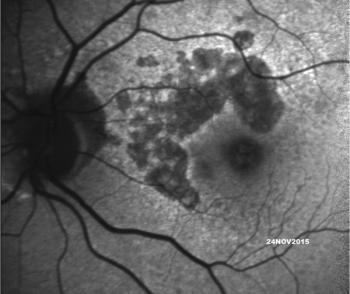
It is important that the ophthalmic community redouble our efforts in following patients with age-related macular degeneration (AMD) using optical coherence tomography (OCT) to find the early signs of geographic atrophy (GA).

The good news for patients is that GA is transitioning from an untreatable disease to a potentially treatable one with development of new therapies to reduce the growth rate, and use of anti-complement therapies have caused the growth rate of GA lesions to decrease.

OCU410 is a modifier gene therapy candidate being developed for geographic atrophy, an advanced stage of dry age related macular degeneration.

Early detection of the disease is key to optimal patient outcomes